If you’ve ever spent an afternoon hunched over a pressure washer, dragging hoses across a driveway or wrestling with a clunky cart on wheels, you already know the frustration. A wall mounted pressure washer solves exactly that problem — and it does it with style, efficiency, and long-term value. Whether you’re a homeowner looking to keep your property spotless or a business owner running a car wash bay, this guide breaks down everything you need to know about wall mounted pressure washers: how they work, what to look for, and why they might be the smartest cleaning investment you make this year.
What Is a Wall Mounted Pressure Washer?
A wall mounted pressure washer is a high-pressure cleaning system permanently or semi-permanently fixed to a wall, post, or structure. Unlike portable units that sit on wheels or the ground, wall mounted systems are installed at a fixed point and connected to a dedicated water supply and, depending on the model, an electrical or fuel-powered motor.
These systems are especially popular in:
- Residential garages for vehicle and driveway cleaning
- Commercial car wash bays and self-service stations
- Agricultural settings for equipment and barn cleaning
- Industrial facilities for heavy-duty surface degreasing
- Municipal maintenance yards and fleet washing bays
The key advantage is space efficiency — the unit is up and out of the way, with hoses either wall-mounted on reels or dropped from overhead. You walk up, grab the wand, and start cleaning. No setup. No dragging. No storage headaches.
Why Choose a Wall Mounted Pressure Washer Over a Portable Unit?
This is one of the most common questions buyers ask, and the answer depends on your use case. But the data paints a clear picture of who benefits most.
Suggested read: Coin Operated Washer and Dryer: Everything You Need to Know Before You Buy or Use One
Space and Convenience
According to a 2023 survey by the Power Washers of North America (PWNA), 68% of commercial pressure washing operators cited “setup time” as one of their top three operational inefficiencies. Wall mounted systems eliminate that entirely. The machine is always ready — water connected, power on, hose on the reel. You show up and clean.
For residential users, a wall mounted unit frees up significant garage or shed floor space. The average portable pressure washer takes up 3–5 square feet of floor space. A wall mounted unit reclaims that space entirely.
Durability and Longevity
Wall mounted pressure washers are typically built to a higher commercial standard than consumer portables. They’re designed for continuous or semi-continuous use, with industrial-grade pumps, heavy-duty motors, and corrosion-resistant frames.
| Feature | Portable Pressure Washer | Wall Mounted Pressure Washer |
|---|---|---|
| Average lifespan | 3–7 years | 8–20+ years |
| PSI range | 1,300–4,000 PSI | 1,500–5,000+ PSI |
| Pump type | Axial (most) | Triplex or plunger (most) |
| Setup time | 5–15 minutes | Under 1 minute |
| Suitable for commercial use | Rarely | Yes |
| Hose reel included | Rarely | Often standard |
| Maintenance frequency | Higher | Lower (with proper care) |
Performance
Wall mounted systems are nearly always connected to a fixed water supply, meaning they benefit from consistent water pressure and flow rates. Portable units that draw from a garden hose can suffer from inconsistent input pressure, reducing overall cleaning performance. A wall mounted pressure washer eliminates that variable.
Types of Wall Mounted Pressure Washers
Not all wall mounted pressure washers are the same. Understanding the different types helps you choose the right unit for your specific needs.
1. Electric Wall Mounted Pressure Washers
Electric models are powered by a standard electrical outlet or hardwired into a panel. They’re:
- Quieter than gas models
- Better suited for indoor use (no exhaust fumes)
- Easier to maintain (no fuel, carburetor, or spark plugs)
- Typically ranging from 1,500 to 3,500 PSI
Electric wall mounted pressure washers are ideal for residential garages, enclosed wash bays, and environments where ventilation is limited.
2. Gas-Powered Wall Mounted Pressure Washers
Gas models deliver significantly more power and are well-suited for heavy outdoor use:
- PSI ranges of 3,000 to 5,000+
- Better for large surface areas and heavy-duty grime
- Require proper ventilation
- Higher maintenance requirements (oil changes, fuel stabilizer, etc.)
These are common in agricultural and industrial settings where maximum cleaning power is non-negotiable.
3. Hot Water Wall Mounted Pressure Washers
Hot water systems heat the water before it exits the nozzle, making them dramatically more effective at removing:
- Grease and oil from concrete floors and engine bays
- Biological contaminants like mold and bacteria
- Food residue in commercial food processing facilities
“Hot water pressure washers can cut cleaning time by up to 35% compared to cold water units when dealing with oily or greasy surfaces.” — Cleaning Industry Research Institute (CIRI)
4. Cold Water Wall Mounted Pressure Washers
Cold water models are the most common and affordable option. They’re excellent for:
Suggested read: Can You Put Shoes in the Washer? Everything You Need to Know Before You Try
- Dirt, mud, and sand removal
- Vehicle exterior washing
- Concrete and driveway cleaning
- General surface maintenance
Key Features to Look for in a Wall Mounted Pressure Washer
Choosing the right wall mounted pressure washer comes down to evaluating several critical specifications. Here’s what to examine before you buy:
PSI (Pounds Per Square Inch)
PSI measures the pressure the unit delivers. Here’s a quick reference:
| PSI Range | Best For |
|---|---|
| 1,500–2,000 PSI | Light residential cleaning, vehicles |
| 2,000–3,000 PSI | Driveways, decks, fences, siding |
| 3,000–4,000 PSI | Commercial bays, fleet washing, concrete |
| 4,000–5,000+ PSI | Industrial, heavy equipment, graffiti removal |
Don’t over-spec your PSI. Using 4,000 PSI on a car finish or wooden deck can cause serious damage. Match your PSI to your application.
GPM (Gallons Per Minute)
GPM measures water flow. Higher GPM = faster cleaning. The real measure of cleaning power is actually the Cleaning Units (CU) formula:
Cleaning Units = PSI × GPM
For example, a 2,000 PSI / 4 GPM machine has 8,000 CU — significantly more cleaning power than a 3,000 PSI / 2 GPM machine at 6,000 CU. Don’t just chase PSI numbers.
Pump Type
The pump is the heart of any pressure washer:
- Axial cam pumps — affordable, suitable for light-duty use, shorter lifespan
- Triplex plunger pumps — industrial-grade, longer lifespan, serviceable, preferred for wall mounted commercial units
- General/Cat pumps — premium brand options widely used in professional installations
Hose Length and Reel
Most quality wall mounted systems include a hose reel — either spring-retractable or manual. Look for:
- Minimum 50 feet of hose for residential use
- 100+ feet for commercial bays or large properties
- Stainless steel or powder-coated reels for corrosion resistance
- Swivel connections to prevent hose kinking
Mounting Hardware and Frame
The mounting system must be robust. Look for:
- Heavy-gauge steel frames with rust-resistant coating
- Wall mounting brackets rated for the unit’s weight
- Easy access panels for pump and motor maintenance
- Cable management for power cords
How to Install a Wall Mounted Pressure Washer
Installation varies by model, but the general process for most wall mounted pressure washers follows these steps:
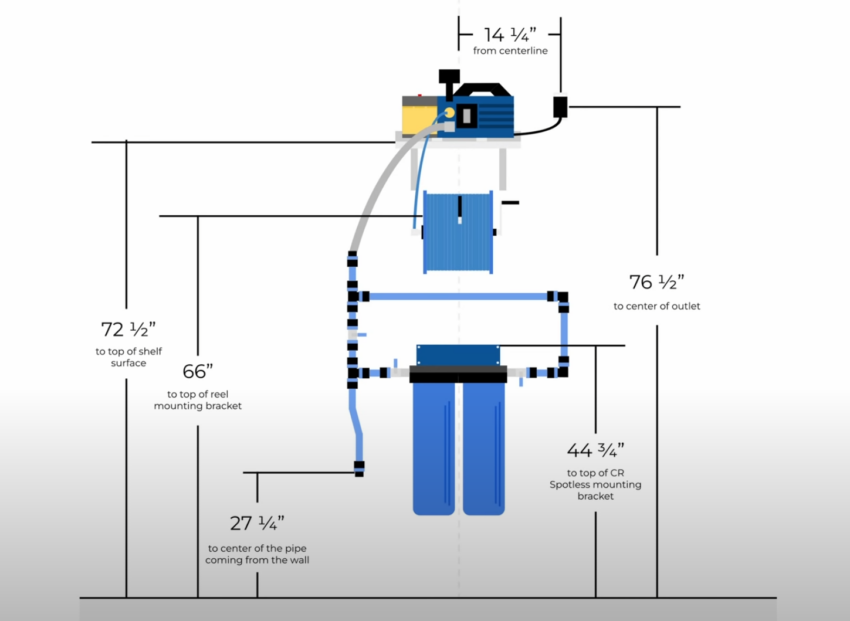
- Choose your location — Near a water supply, power source, and with enough hose reach to cover your target area
- Mark and drill anchor points — Use a stud finder; mount into studs or use wall anchors rated for the unit’s weight
- Mount the bracket and unit — Follow manufacturer torque specs; don’t under-tighten
- Connect the water supply — Use the correct inlet size (typically 3/4″ or 1″ garden hose fitting); install an inline filter
- Connect power — For electric models, ensure your circuit is rated correctly (most require 15–20A dedicated circuits)
- Install the hose reel — Mount adjacent to the unit at a comfortable working height
- Test the system — Run water through before powering on; check for leaks at all connections
- Install nozzles and accessories — Start with a low-pressure nozzle for initial testing
Pro Tip: Always install a pressure regulator and thermal relief valve on your supply line. These protect both your equipment and your plumbing from pressure spikes and heat buildup.
Suggested read: Zoom Car Wash: Everything You Need to Know Before You Go
Wall Mounted Pressure Washer for Car Washing: A Closer Look
One of the most popular applications for wall mounted pressure washers is vehicle cleaning. Whether you’re running a self-service bay or washing your own fleet at home, a wall mounted setup transforms the experience.
For car washing specifically, you’ll want:
- 1,500–2,500 PSI (lower end protects paint and seals)
- 2.0+ GPM for effective rinsing
- Foam cannon attachment capability for pre-soak applications
- Variable pressure nozzles (0°, 15°, 25°, 40°, and soap nozzle)
- Warm or hot water capability for degreasing wheel wells and undercarriages
If you’re looking for a dedicated automated solution, a car auto wash machine might complement your wall mounted setup perfectly — especially for commercial operations handling high vehicle volumes.
Case Study: Self-Service Car Wash Bay Installation
A small car wash operator in Texas installed four wall mounted pressure washer bays in 2021. Here’s what they reported after 18 months:
- Revenue per bay increased by 22% due to faster customer turnaround
- Maintenance costs dropped 30% compared to their previous portable unit setup
- Customer satisfaction scores improved because hoses were organized and bays were cleaner
- Water usage decreased by 15% thanks to consistent flow regulation from fixed supply lines
This real-world example illustrates why wall mounted systems pay for themselves relatively quickly in commercial contexts.
Top Brands for Wall Mounted Pressure Washers
Several manufacturers have built strong reputations in this category:
Mi-T-M Corporation
A leading US-based manufacturer offering a wide range of wall mounted electric and gas units. Known for triplex pump reliability and excellent parts availability.
Shark / BE Pressure
Popular in commercial settings, Shark and BE Pressure offer heavy-duty hot and cold water wall mounted systems with robust frame construction.
Karcher
The global leader in cleaning technology, Karcher offers wall mounted solutions at both residential and commercial scales, with smart features like auto-stop technology that halts the pump when the trigger is released, extending motor life significantly.
General Pump
Not a washer brand per se, but General Pump manufactures the triplex pumps used in many premium wall mounted systems. If your unit says “General Pump inside,” that’s a very good sign.
Simpson Cleaning
Simpson offers rugged wall mounted units with CAT pump options, particularly well-suited for agricultural and industrial environments.
Suggested read: Perfume Free Washing Powder: Everything You Need to Know for Sensitive Skin
Maintenance Tips for Your Wall Mounted Pressure Washer
A wall mounted pressure washer is a long-term investment. Protecting that investment means staying on top of maintenance:
Regular Maintenance Tasks
- Check inlet filter screen monthly — clogged screens reduce flow and damage the pump
- Inspect hose for wear — look for cracks, kinks, or abrasion marks
- Test safety valve quarterly — ensure the thermal relief valve opens and closes properly
- Lubricate fittings — use appropriate thread sealant and lubricant on quick-connect fittings
- Flush the system after use with clean water, especially if you’ve used detergent
Seasonal Maintenance
- Winterize properly — if your unit is in an unheated space, pump-saver fluid prevents freeze damage
- Check pump oil (for oil-lubricated pumps) — change annually or per manufacturer recommendation
- Inspect motor brushes (for electric units) — worn brushes reduce efficiency
Common Problems and Solutions
| Problem | Likely Cause | Solution |
|---|---|---|
| Low pressure | Clogged nozzle or inlet filter | Clean or replace nozzle/filter |
| Pulsating pressure | Air in the pump | Purge air by running without nozzle briefly |
| Water leaking from pump | Worn seals | Replace pump seals (or call a technician) |
| Motor won’t start | Tripped GFCI or thermal overload | Reset breaker/overload; check power supply |
| Hose won’t retract | Broken reel spring | Replace spring cartridge |
Wall Mounted Pressure Washer vs. Reel-Only Systems
Some buyers confuse wall mounted pressure washers with simply mounting a hose reel on the wall. These are very different things:
- A wall mounted hose reel stores a garden hose at low pressure — useful for watering, not cleaning
- A wall mounted pressure washer generates high-pressure output (1,500–5,000+ PSI) for actual surface cleaning
If you need genuine cleaning power, a wall mounted pressure washer is the appropriate choice. Hose reels alone won’t remove grease, caked-on dirt, mold, or road grime effectively.
Cost Breakdown: Wall Mounted Pressure Washer Investment
Understanding the full cost of ownership helps you budget accurately:
Purchase Price Ranges
| Category | Price Range |
|---|---|
| Entry-level residential electric | $300–$700 |
| Mid-range residential/light commercial | $700–$1,500 |
| Commercial cold water | $1,500–$4,000 |
| Commercial hot water | $3,000–$10,000+ |
| Industrial heavy-duty | $8,000–$25,000+ |
Installation Costs
- DIY installation: $0–$100 (hardware and fittings)
- Professional installation (basic): $200–$500
- Full commercial bay installation (plumbing + electrical): $1,000–$5,000+
Operating Costs
- Water: Typically $0.01–$0.03 per gallon depending on your utility rate
- Electricity: An average 1,800W electric unit running 1 hour = ~$0.22 at $0.12/kWh
- Maintenance: Budget 5–10% of purchase price annually
Environmental Considerations
Wall mounted pressure washers, when used responsibly, can actually be more environmentally friendly than traditional hand washing:
- The EPA estimates that hand washing a car uses 80–140 gallons of water per wash
- A pressure washer typically uses 15–70 gallons depending on PSI and GPM
- Closed-loop reclaim systems can be added to commercial installations to recycle and filter wash water for reuse, reducing water consumption by up to 85%
Additionally, many modern wall mounted systems are compatible with biodegradable, phosphate-free detergents that minimize environmental impact on storm drains and groundwater.
Frequently Asked Questions About Wall Mounted Pressure Washers
What PSI is best for a wall mounted pressure washer for home use?
For most residential applications, a wall mounted pressure washer with 1,800–2,800 PSI offers the ideal balance of cleaning power and surface safety. This range handles driveways, siding, decks, and vehicles without risking damage to softer surfaces.
Can I install a wall mounted pressure washer myself?
Yes, many homeowners successfully install wall mounted pressure washers as a DIY project. You’ll need basic plumbing knowledge (to connect the water supply) and electrical competence (to wire or plug in the unit). However, for hot water systems or commercial installations requiring dedicated circuits or plumbing runs, hiring a licensed plumber and electrician is strongly recommended.
How long does a wall mounted pressure washer last?
With proper maintenance, a quality wall mounted pressure washer with a triplex pump can last 15–20 years or more. Axial pump models typically last 5–10 years. The key factors are pump quality, frequency of use, water quality, and adherence to the maintenance schedule.
Is a wall mounted pressure washer worth it for a single-family home?
It depends on how frequently you use it. If you wash your driveway, vehicles, siding, or deck more than 8–10 times per year, the convenience and durability of a wall mounted unit often justify the higher upfront cost compared to a portable unit. Many homeowners report they use their pressure washer far more often once it’s permanently installed and always ready to use.
What type of detergent can I use with a wall mounted pressure washer?
Most wall mounted pressure washers are compatible with pressure washer-specific detergents in either downstream or upstream injection configurations. Never use bleach in a unit not rated for it — it will corrode the pump seals. Look for:
- Vehicle wash soaps for cars and trucks
- Concrete degreasers for driveways and shop floors
- Mold and mildew removers for siding and decks
- Aluminum brighteners for trailers and farm equipment
How do I prevent my wall mounted pressure washer from freezing in winter?
To winterize your wall mounted pressure washer:
Suggested read: Wash Hall: Everything You Need to Know About Communal Laundry Facilities
- Disconnect and drain the water supply line
- Run the pump briefly to expel residual water
- Add pump-saver antifreeze fluid (like Pump Guard) through the inlet
- Cover the unit if it’s in an unheated space
What is the difference between a wall mounted pressure washer and a stationary pressure washer?
The terms are often used interchangeably. Both describe units that are fixed in one location rather than being moved on wheels. “Wall mounted” specifically refers to units attached to a wall structure, while “stationary” may also include units bolted to a floor-mounted skid frame.
Conclusion: Is a Wall Mounted Pressure Washer Right for You?
If you value convenience, durability, and long-term performance, a wall mounted pressure washer is one of the most practical upgrades you can make to your cleaning setup. It eliminates setup time, stays out of your way when not in use, and delivers consistent, professional-grade results every time you pull the trigger.
For homeowners, it transforms routine cleaning tasks from chores into quick, satisfying jobs. For business owners, especially those running car wash bays or fleet maintenance operations, it’s not just a convenience — it’s a competitive advantage that pays dividends in efficiency, uptime, and customer experience.
Before you buy, evaluate your PSI needs, available space, water supply configuration, and budget. Whether you go electric or gas, hot water or cold, residential or commercial — the wall mounted format is almost always the smarter long-term choice once your needs justify a permanent installation.
Ready to take the next step? Explore your options and find the right wall mounted pressure washer for your specific needs today — and experience the difference that a properly installed, always-ready cleaning system makes.
Sources & Citations
- Power Washers of North America (PWNA) — Industry Operational Survey, 2023
- Cleaning Industry Research Institute (CIRI) — Hot vs. Cold Water Pressure Washing Efficiency Study
- U.S. Environmental Protection Agency (EPA) — WaterSense: Outdoor Water Use in the United States
- Karcher USA — Product Technical Documentation, 2024
- Mi-T-M Corporation — Commercial Pressure Washer Specifications Guide
- Wall Mounted Pressure Washer — WashSelfService.com