In this guide
Hardwood Floor Washing Machine vs Spin Mop: Which Is Right for Your Floors?
The phrase “hardwood floor washing machine vs spin mop” can be confusing because “washing machine” sounds like a laundry appliance. In floor care, though, it usually refers to a powered cleaner that applies liquid to your floors. A spin mop can mean anything from a manual bucket-and-wringer mop to a corded or cordless electric mop with spinning pads. Both can work on sealed hardwood, but the deciding factor is almost always how much water you let touch the wood.
What a Hardwood Floor Washing Machine Includes
A roundup of hardwood floor cleaner machines describes the category as covering several different tools [1]:
– Standard vacuums use suction to lift soil and debris, but they do not use water or cleaning solutions [1].
– Wet/dry vacuums dispense cleaning solution dissolved in water, then use suction to lift both the soil and the dirty water from the floor [1].
– Robotic vacuums and mops move automatically and perform both wet-mopping and vacuuming in response to remote controls, apps, or voice commands [1].
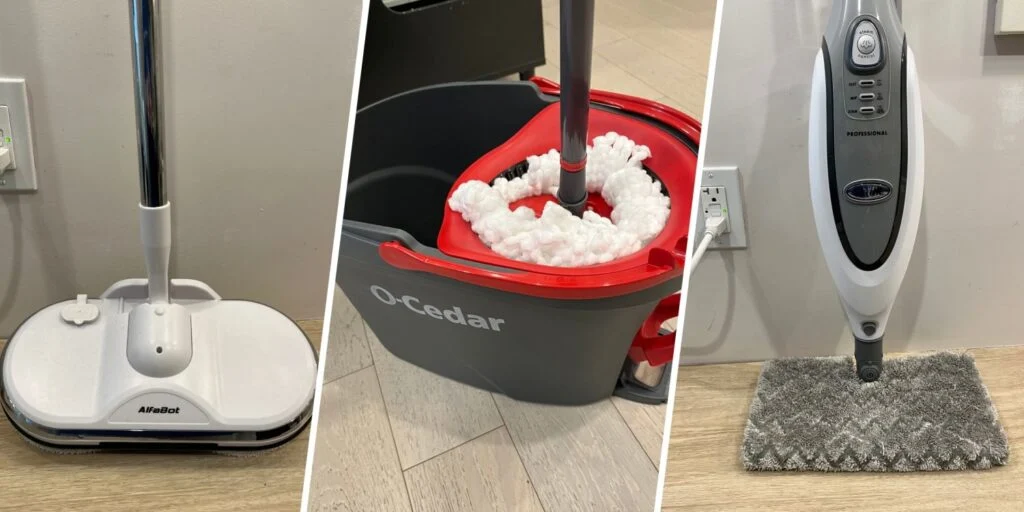
– Steam mops contain heating elements that heat water to produce pressurized steam, so they don’t need cleaning solutions or chemicals [1].
– Spin mops dispense cleaning solution onto floors and scrub the surface with rotating pads on dual spinning mopheads [1].
So when you compare a “washing machine” and a “spin mop,” you may actually be comparing two overlapping categories. A spin mop can itself be a hardwood floor cleaning machine.
What a Spin Mop Does Well on Hardwood
Spin mops have a strong reputation on sealed hardwood. In one test, spin mops were called a great choice for cleaning hardwood floors because they help you avoid using too much water [3]. The O-Cedar EasyWring, for example, uses a foot-activated spinning wringer, so you can wring out excess water hands-free while cleaning [3].
Electric spin mops can also be effective. The Bissell SpinWave corded electric floor mop features two spinning mopheads that scrub sealed hardwood floors and tile. It is designed to safely bring out a shine while the spinning pads scrub away soils and spills [1]. Its on-demand spray system gives you more control over how much cleaning solution reaches the floor [1]. Testers rated it high for ease of use and maneuverability, but at 9.5 pounds it is heavy, and it may not be capable of pulling grout stains [1].
The Bissell SpinWave Cordless Pet Hard Floor Spin Mop is another example. Unlike manual spin mops that use a foot pedal built into a bucket, this cordless model has a water reservoir connected to it. That makes it easier to move around because you don’t need to carry a bucket, though it is heavier than other mops [3]. Testers found it glides easily and cleans stubborn messes like butter in fewer than 10 swipes using only water, but they also noted that cleaning initially requires a bit of trial and error because it works differently from manual spin mops [3].
Manual spin mops have limits too. The O-Cedar EasyWring cleans spills well, but messes like marinara sauce and dirt require the additional step of picking up larger pieces of debris with a broom or paper towel first [3]. Its triangular mop head doesn’t swivel, but the long microfiber strands reach into corners and clean along baseboards with ease [3].
The Conflict: Are Spin Mops Safe on Hardwood?
Not every source agrees about spin mops and hardwood. One social-media post warns that spin mops are not one-size-fits-all and says they are great for floors like LVP, LVT, tile, polished concrete, and linoleum, but not for cleaning hardwood and engineered wood [4]. Meanwhile, another test says spin mops are a great choice for hardwood floors [3], and a spin mop guide states that spin mops are safe for all types of hard floors because they don’t use heat, which eliminates the risk associated with steam mops [5].
So how do you handle the contradiction? The key is not to treat “spin mop” as one single product category.
The electric Bissell SpinWave reviewed for sealed hardwood uses an on-demand spray, which means you can add liquid only when you need it [1]. The manual O-Cedar EasyWring uses a foot pedal to wring out excess water before the mop head touches the floor [3]. A generic spin mop with a saturated mop head and no wringing control is a different situation. Before buying, verify the specific product’s care instructions, then check the flooring manufacturer’s guidance for sealed hardwood, engineered wood, and your warranty requirements [2][4]. If a floor finish isn’t listed as safe for wet mopping, don’t assume a spin mop changes that.
Suggested read: Wall-Mounted vs Portable Pressure Washer Reel: How to Choose
How an Electric Washing Machine Changes the Equation
An electric floor washing machine can be more convenient, but it also comes with its own caveats. A wet/dry vacuum is built to dispense cleaning solution dissolved in water and then suction the soil and dirty water back up [1]. That can be useful for wet messes, but you still need to make sure the machine’s cleaning method is acceptable for your specific hardwood floor.
A robotic vacuum and mop performs wet-mopping and vacuuming automatically [1]. That sounds convenient, but because you are not controlling the liquid application directly, you need to pay even closer attention to the manufacturer’s guidance about which floor types it can handle.
Steam mops are a separate case. They use heat to produce pressurized steam and do not require cleaning solutions [1]. One comparison notes that spin mops don’t use heat, which eliminates the heat-damage risk of steam mops [5]. A community conversation about floor care also warns simply that heat plus water plus wood equals warp [6]. If you are choosing between a steam-based washing machine and a spin mop, the spin mop avoids the heat concern [5], but you should still confirm your flooring manufacturer’s wet-cleaning instructions [2].
Water Control Is the Deciding Factor
For hardwood, the most important thing is liquid control. As Aaron Christensen, vice president of growth at the nationwide house-cleaning service platform Homeaglow, put it: “If you’re using mops on hardwood floors, it’s more about control of liquid.” He also recommends models that use low amounts of moisture or have on-demand cleaning solutions [1].
A spin mop can be useful for deeper wet-cleaning tasks, particularly where heavier soil, spills, or greater moisture control are involved [2]. For sealed hardwood, a flat microfiber mop can also be suitable when used with controlled moisture [2]. The Cleaning Station explains that for routine maintenance, a flat microfiber mop can be convenient, while for heavier wet cleaning, a spin mop may provide more practical water control [2].
So the real question isn’t “machine vs spin mop.” It’s “how much water will this tool leave on the wood, and how much effort do you want to put in?”
Which One Should You Choose?
Choose a spin mop if:
– You want hands-free water removal with a foot pedal wringer [3].
– You want to keep moisture low on sealed hardwood [1][3].
– You don’t mind a learning curve when switching from a bucket-based mop to an electric spin mop [3].
– You are willing to pick up larger debris before mopping, because a spin mop does not vacuum [3].
Choose an electric floor washing machine if:
– You want a wet/dry vacuum that can dispense cleaning solution and then suction the liquid and soil from the floor [1].
– You want an automated mop/vacuum option [1].
– You need help with larger or messier jobs, but you are prepared to verify that the machine and your floor finish are compatible [1][2].
Be careful with a steam mop on hardwood. Because of the heat and moisture involved, a spin mop’s no-heat operation can be an advantage [5][6]. Only proceed with a steam mop if your hardwood flooring manufacturer explicitly allows it.
Before You Buy: What to Verify
Product prices, stock, discounts, ratings, shipping, availability, package contents, accessories, compatibility, and model-year details all change over time. The only way to know the current status of a specific floor cleaner or spin mop is to check the manufacturer’s listing and the current retailer listing.
Also verify these key details before purchasing:
– Confirm that your wood is sealed and that the specific finish allows wet mopping [1][2].
– Check the mop’s own instructions to see whether it is approved for hardwood or engineered wood [4].
– Look for a model with low-moisture use or on-demand spray control [1].
– If the machine includes cleaning solution, verify that the solution is suitable for your floor finish [1].
– If you are considering a manual spin mop with a bucket, make sure the wringer removes enough excess water before the mop head touches the wood [3].
Final Takeaway
A spin mop can be a great choice for sealed hardwood because it helps you avoid using too much water [3]. An electric floor washing machine may help with larger messes, but if it uses steam, check the heat and moisture risks before you buy [5][6]. The most important step is checking the flooring manufacturer’s care instructions and the specific product label, because not every spin mop is built for every wood floor [2][4].
Suggested read: Hotpoint vs Whirlpool Washer and Dryer: What the Available Info Actually Tells You
Sources
1. The Best Hardwood Floor Cleaner Machines, Tested and Reviewed
2. Flat Mop vs Spin Mop: Which One Cleans Best? – The Cleaning Station
3. The 6 Best Mops for Hardwood Floors, Tested by BHG
4. Spin Mops are not a one-size-fits-all kind of mop
5. Steam Mop vs Spin Mop: Which Wins? | Dreame CA
6. What are the pros and cons of using steam mops or spin mops? – Facebook